जय श्री ब्रह्मा जी
Lord Brahma is one of the important deities in Hindu traditions and is traditionally associated with the creation of the universe and living beings. He is one of the three deities commonly known as the Trimurti, together with Lord Vishnu and Lord Shiva. Brahma is connected with creation, knowledge, the Vedas and the beginning of cosmic cycles.
The story of Lord Brahma is found in different Hindu scriptures and traditions. Because Hinduism contains many schools of thought and many sacred texts, the story of Brahma's birth and creation can be told in more than one way. Some traditions describe Brahma appearing from a lotus connected with Lord Vishnu, while other accounts connect his origin with the cosmic golden egg known as Hiranyagarbha.
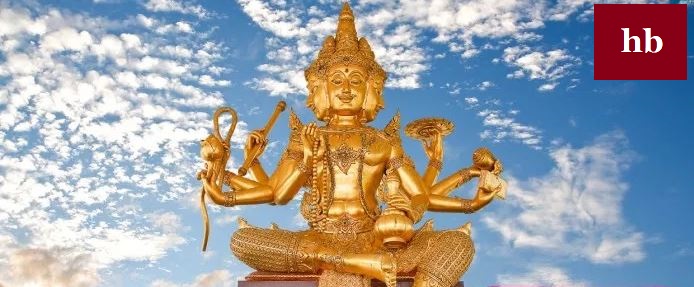
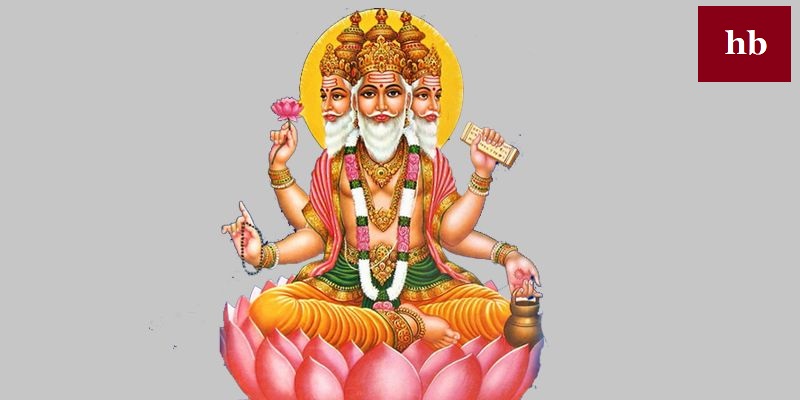
Lord Brahma is usually shown with four faces and four arms. He may be seen holding a rosary, a book or sacred texts, a water pot and other traditional objects. His vehicle is the Hamsa or swan. His four faces, lotus seat and other symbols have important meanings in Hindu religious traditions.
This page explains the Lord Brahma birth story, his role in creation, his four faces, the four Vedas, his connection with Goddess Saraswati, the famous Brahma Temple at Pushkar, the story of Shiva's curse and other important facts about Brahma.
Who Is Lord Brahma?
Lord Brahma is traditionally known as the deity associated with creation. In the familiar Trimurti concept, Brahma is associated with creation, Vishnu with preservation and Shiva with transformation or dissolution. This is a simple way of understanding their roles, although different Hindu traditions explain these relationships in different ways.
Brahma is also associated with knowledge, sacred learning and the Vedas. His traditional appearance reflects these associations. He is generally shown with four faces, four arms, a rosary and a water pot. He may also hold a book representing knowledge.
The name Brahma should not be confused with Brahman. Brahma is the name of a deity, while Brahman is a philosophical term used in Hindu thought for ultimate reality or the supreme spiritual principle. These two words have different meanings even though they sound similar in English.
In Hindu mythology, Brahma is often described as taking part in the creation of worlds, beings, sages and cosmic principles. His stories are therefore closely connected with Hindu ideas about how the universe begins and how creation continues through cosmic cycles.
Lord Brahma Birth Story
There is more than one traditional account of the birth of Lord Brahma. This is important because Hindu scriptures do not always describe creation in exactly the same way. Different Puranas and religious traditions preserve different versions of the story.
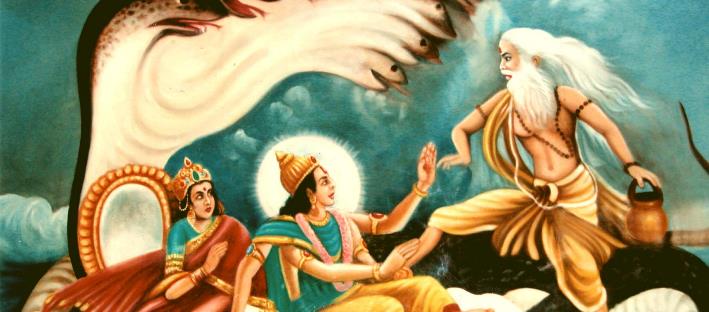
One of the best-known stories says that Lord Brahma appeared from a lotus flower that emerged from the navel of Lord Vishnu. Vishnu is described as resting upon Ananta Shesha in the cosmic waters. From Vishnu's navel came a beautiful lotus, and Brahma appeared on the lotus.
Brahma then began searching for the source of the lotus and his own origin. The story describes his effort to understand the vast universe around him. Eventually he received the knowledge and inspiration needed to begin his role in creation.
Another important tradition connects Brahma with Hiranyagarbha, the golden cosmic egg. The golden egg is a powerful image of the beginning of creation and the emergence of the universe from a primordial state.
Some traditions also describe Brahma as Svayambhu, meaning self-born. These different accounts show the variety of Hindu creation traditions.
How Was Lord Brahma Born From the Lotus?
The lotus-birth story is one of the most popular stories about Lord Brahma. According to this tradition, Lord Vishnu rested in the cosmic ocean. A lotus flower emerged from Vishnu's navel, and Brahma appeared on the lotus.
Brahma found himself in a vast and mysterious universe. He wanted to understand where he had come from and what his purpose was. The story describes his search for the beginning of the lotus and the source of his existence.
The lotus eventually became an important symbol associated with Brahma. In Hindu symbolism, the lotus is often connected with purity, spiritual growth and creation. The image of Brahma sitting on a lotus therefore carries both a story and a symbolic meaning.
The lotus-birth account is especially well known in Vaishnava traditions, while other Hindu texts provide different explanations of Brahma's origin.
Hiranyagarbha and the Golden Egg
Another important creation concept connected with Brahma is Hiranyagarbha, often translated as the golden womb or golden egg. It represents the cosmic source from which creation emerges.
In traditional Hindu thought, creation is sometimes described as beginning from an unmanifest or primordial state. The golden egg becomes a symbolic representation of the universe before its different forms and beings appear.
Some later religious traditions connect Brahma with this cosmic principle of creation. The story of Hiranyagarbha is therefore an important part of understanding why Brahma is associated with the beginning of the universe.
The lotus story and the Hiranyagarbha tradition should not necessarily be treated as competing historical accounts. They belong to different religious and scriptural traditions that use different symbols to explain creation.
Lord Brahma and the Creation of the Universe
Lord Brahma is traditionally associated with the creation of the universe and all forms of life. Hindu cosmology describes creation as a vast process that takes place through repeating cycles of time.
In Puranic stories, Brahma creates different beings, worlds and cosmic entities. His creative activity includes the creation of sages, Prajapatis and other beings who continue the process of creation.
Brahma's creation is not always described as a single event. Hindu cosmology often presents the universe as moving through cycles of creation, existence and dissolution. A new cycle begins after the previous cosmic cycle comes to an end.
This makes Brahma's role different from the idea of a creator acting only once. He is connected with the recurring process of cosmic creation.
Brahma and the Saptarishis
The Saptarishis, or seven great sages, are important figures in Hindu mythology. Different scriptures give different names and accounts of these sages, but they are generally connected with wisdom, spiritual knowledge and the continuation of creation.
Some traditions connect Brahma with the creation or origin of great sages. These sages are then described as helping to spread knowledge and continue the cosmic order.
The stories of Brahma and the sages show that creation in Hindu mythology is not limited to physical beings. Knowledge, spiritual traditions, family lines and social order are also connected with the process of creation.
Brahma and the Prajapatis
The Prajapatis are another group of important figures in Hindu creation stories. The word Prajapati is commonly associated with a lord or progenitor of living beings.
Puranic traditions describe Brahma as creating or bringing forth Prajapatis who help populate the universe. Their descendants become part of the continuing story of creation.
These stories explain creation as an expanding process. Brahma begins the creative process and other beings continue it through generations and cosmic functions.
Lord Brahma and the Four Vedas
Lord Brahma is strongly associated with the four Vedas: the Rig Veda, Yajur Veda, Sama Veda and Atharva Veda.
The Vedas are among the oldest sacred texts of Hindu traditions. Brahma's connection with them reinforces his association with knowledge, sacred learning and cosmic order.
His four faces are traditionally connected with the four Vedas. This is one reason why the four-faced form of Brahma is so important in Hindu iconography.
Brahma's connection with knowledge also explains why his images often include a book or sacred text. The book is a visual symbol of wisdom and learning.
Why Does Lord Brahma Have Four Faces?
One of the most recognizable features of Lord Brahma is his four faces. Traditional images show the faces looking toward the four directions.
The four faces are commonly associated with the four directions and the four Vedas. Because Brahma represents knowledge and creation, the four-faced form also gives the image a sense of completeness and awareness in every direction.
Brahma is therefore often called Chaturmukha Brahma, meaning four-faced Brahma.
Some traditional stories also explain Brahma's fifth head. The most famous account connects the loss of the fifth head with a story involving Lord Shiva. This story is discussed below.
Meaning of Lord Brahma's Four Arms
Lord Brahma is generally shown with four arms. Like his four faces, the four arms are rich in symbolic meaning.
The objects in Brahma's hands can vary between different images and traditions. A rosary represents prayer and the passage of time. A water pot, or kamandalu, is associated with purity and creation. A book or sacred text represents knowledge.
The four arms together create an image of a deity connected with knowledge, sacred activity and creation.
Symbols of Lord Brahma
The traditional image of Lord Brahma contains several symbols. Each object helps explain an aspect of Brahma's role and significance.
Four Faces: The four faces are associated with the four directions and are traditionally connected with the four Vedas.
Four Arms: The four arms represent the completeness of Brahma's divine role and hold objects connected with knowledge, prayer and creation.
Rosary: The rosary is associated with prayer, spiritual practice and time.
Book: The book represents knowledge, sacred learning and wisdom.
Kamandalu: The water pot is a traditional symbol of purity and is often seen in the hands of sages and deities.
Lotus: The lotus is associated with purity, beauty and creation. It is especially important in the story of Brahma's birth from the lotus.
Hamsa: The swan is Brahma's traditional vehicle and is associated with wisdom and discrimination.
Why Is the Swan Associated With Lord Brahma?
The Hamsa or swan is traditionally regarded as the vehicle of Lord Brahma. It is an important part of Brahma's iconography.
The swan is traditionally connected with wisdom and discrimination. In symbolic interpretations, it represents the ability to distinguish between different things and to seek deeper knowledge.
Since Brahma is associated with creation and knowledge, the Hamsa is an appropriate symbol in his traditional representation.
Lord Brahma and Goddess Saraswati
Goddess Saraswati is traditionally associated with knowledge, wisdom, learning, music and the arts. She is also closely associated with Brahma in Hindu religious traditions.
The association of Brahma and Saraswati creates a strong connection between creation and knowledge. Brahma represents the creative principle, while Saraswati represents knowledge and learning.
Saraswati is often shown with a veena, sacred texts and a swan. Her imagery emphasizes wisdom, education, music and artistic expression.
The traditions surrounding Brahma and Saraswati have developed in different ways across Hindu literature, and individual stories may vary.
Lord Brahma in the Trimurti
Lord Brahma is traditionally described as one member of the Trimurti. The three deities commonly included are Brahma, Vishnu and Shiva.
Brahma is associated with creation, Vishnu with preservation and Shiva with transformation or dissolution. This threefold idea provides a simple framework for understanding the continuous cycle of the universe.
However, Hindu traditions are diverse. Different scriptures and philosophical schools explain the Trimurti in different ways. Some traditions place Vishnu in the highest position, others emphasize Shiva, while Shakta traditions place Goddess Devi at the center.
Therefore, the role of Brahma should be understood within the particular Hindu tradition or scripture being discussed.
Lord Brahma and the Cycle of Creation
Hindu cosmology describes time as a series of enormous cycles. Creation, existence and dissolution are part of this continuing cosmic process.
Brahma is traditionally associated with the creative phase. His day and night are described in Puranic cosmology using enormous periods of time, far beyond ordinary human measurement.
At the end of a cosmic period, creation undergoes dissolution, after which another cycle begins. This idea presents the universe as a repeating process rather than something that happens only once.
The cosmic role of Brahma is therefore closely connected with Hindu ideas about time, change and the continuing renewal of creation.
Lord Brahma Worship and His Temple
Lord Brahma has comparatively fewer major temples dedicated specifically to him than Lord Vishnu and Lord Shiva. Nevertheless, Brahma remains an important figure in Hindu religious literature and mythology.
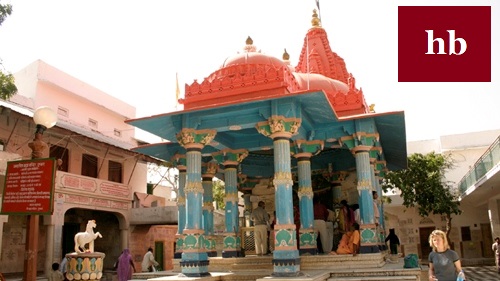
The most famous temple associated with Brahma is the Jagatpita Brahma Mandir in Pushkar, Rajasthan. Pushkar is an important pilgrimage destination and is traditionally associated with Lord Brahma.
The temple is located close to the sacred Pushkar Lake. Devotees and visitors travel to Pushkar throughout the year, and the town becomes especially important during religious festivals such as Kartik Purnima.
The Brahma Temple at Pushkar is therefore one of the most recognizable places associated with the worship of Lord Brahma.
Story of Lord Brahma and Pushkar
Hindu traditions connect Pushkar with Lord Brahma through several sacred stories. One well-known tradition tells of Brahma deciding to perform a sacred yajna at Pushkar.
The sacred lake and the surrounding pilgrimage area are therefore strongly associated with Brahma. Pushkar became an important religious center, and the Brahma temple remains one of its major attractions.
Different versions of the Pushkar story contain different details, particularly concerning Brahma's consort and the performance of the yajna. These variations are part of the wider diversity of Hindu mythology.
Why Are There So Few Lord Brahma Temples?
One common question is why there are comparatively few temples dedicated to Lord Brahma.
Several Hindu traditions contain stories that explain this situation. One of the most famous stories involves Brahma, Vishnu and Shiva and describes a disagreement about supremacy.
In the story, Brahma makes a claim that Shiva considers untruthful. Shiva then curses Brahma, and the story becomes one traditional explanation for Brahma's limited worship.
It is important to remember that this is a religious story from Hindu mythology and that different scriptures and traditions preserve different versions of the episode.
Why Did Lord Shiva Curse Lord Brahma?
One of the best-known stories about Brahma's curse begins with a dispute between Lord Brahma and Lord Vishnu. According to the traditional story, both wanted to establish who was superior.
Lord Shiva appeared as a huge pillar of light or fire between them. The pillar seemed to have no visible beginning or end.
Vishnu took the form of a boar and travelled downward to find the bottom of the pillar. Brahma took the form of a swan and travelled upward to find its top.
Vishnu eventually accepted that he could not find the end of the pillar. In the traditional account, Brahma encountered a Ketaki flower and decided to use the flower as evidence that he had reached the top.
Shiva then appeared and challenged Brahma's claim. Because Brahma had spoken falsely, Shiva became angry.
In the story, Shiva's manifestation removes Brahma's fifth head. Brahma is thereafter commonly represented with four faces.
This story is also connected with the traditional explanation of why Brahma has comparatively few temples dedicated to his worship.
Story of Brahma's Fifth Head
Traditional images of Brahma generally show four faces. Some Hindu stories, however, describe Brahma as once having five heads.
The story of the fifth head is connected with Brahma's conflict with Shiva. In the famous account of the infinite pillar of light, Brahma makes a false claim about finding the top of the pillar.
Shiva becomes angry and removes one of Brahma's heads. From that point onward, Brahma is commonly shown with four heads.
The story is often understood as a traditional lesson about humility and truthfulness.
The Story of Brahma, Vishnu and Shiva
Brahma, Vishnu and Shiva appear together in many Hindu stories. Their relationship can be understood through the idea of creation, preservation and transformation.
In the story of the pillar of light, Brahma and Vishnu compete to discover its limits. Shiva appears as the infinite reality beyond their ability to measure.
Vishnu accepts the truth, while Brahma gives a false account of his journey. Shiva's response becomes an important part of the story of Brahma's fifth head and his limited worship.
The story has been interpreted in different ways by different Hindu traditions, and its details may differ between texts.
Lord Brahma's Role in Hindu Mythology
Brahma appears in many Hindu texts, particularly in stories dealing with creation, sages, gods, demons, humans and the organization of the universe.
He is often presented as a powerful divine being who begins the process of creation, but he is not necessarily described as the ultimate supreme reality in every Hindu tradition.
This distinction is important because Hindu mythology contains many different theological viewpoints. A story from one tradition may describe Brahma differently from a story preserved in another tradition.
Lord Brahma and Knowledge
Knowledge is one of the strongest themes associated with Lord Brahma. His connection with the Vedas, sacred texts and Saraswati places him within a wider tradition of learning and wisdom.
His four faces and traditional objects communicate the idea that creation is connected with knowledge. The universe is not simply created as physical matter; it is also organized through cosmic principles and order.
For this reason, Brahma's traditional imagery is often studied not only as mythology but also as a collection of symbols representing knowledge and creation.
What Can We Learn From Lord Brahma?
The traditional stories of Brahma contain several symbolic lessons.
His association with knowledge reminds people of the importance of learning and understanding. His connection with creation can be viewed as a reminder that new beginnings require responsibility.
The story of Shiva and Brahma also places importance on truthfulness and humility. Brahma's attempt to claim something he had not achieved becomes the reason for his punishment in the traditional story.
The lotus associated with Brahma can also be understood as a symbol of purity and spiritual growth. The lotus grows in water while remaining above it, making it a powerful symbol in Hindu traditions.
Important Names of Lord Brahma
Lord Brahma is known by several names in Hindu religious literature.
Brahma: His most commonly used name.
Prajapati: A title associated with the progenitor or lord of living beings.
Pitamaha: A name meaning grandfather or ancient ancestor, reflecting Brahma's connection with creation.
Chaturmukha: Meaning four-faced, referring to Brahma's traditional four faces.
Svayambhu: A term meaning self-born, used in traditions describing Brahma's origin.
Hiranyagarbha: A name or concept connected with the golden cosmic source of creation in Hindu traditions.
Interesting Facts About Lord Brahma
Lord Brahma is traditionally associated with creation.
He is one of the three deities of the Trimurti in many Hindu traditions.
Brahma is commonly represented with four faces and four arms.
His four faces are traditionally connected with the four directions and the four Vedas.
His traditional vehicle is the Hamsa or swan.
Brahma is strongly associated with knowledge and sacred learning.
Goddess Saraswati is traditionally associated with Brahma.
The famous Brahma Temple is located at Pushkar in Rajasthan.
Different Hindu scriptures contain different accounts of Brahma's origin.
One famous tradition describes Brahma emerging from a lotus connected with Lord Vishnu.
Another creation tradition connects Brahma with Hiranyagarbha, the golden cosmic egg.
A famous Puranic story explains Brahma's four-headed form through an episode involving Lord Shiva.
Frequently Asked Questions About Lord Brahma
Who is Lord Brahma?
Lord Brahma is a Hindu deity traditionally associated with creation. He is one of the Trimurti in many Hindu traditions and is closely connected with the Vedas, knowledge and the creation of living beings.
How was Lord Brahma born?
One famous Hindu tradition says that Brahma appeared from a lotus that emerged from Lord Vishnu's navel. Other traditions connect his origin with Hiranyagarbha or describe him as self-born.
Who is the father of Lord Brahma?
There is no single answer accepted across all Hindu traditions because different scriptures describe Brahma's origin differently. In the famous lotus-birth tradition, Brahma emerges from the lotus connected with Lord Vishnu.
Why does Lord Brahma have four heads?
Brahma is traditionally shown with four faces facing the four directions. They are commonly associated with the four Vedas and the four directions of the universe.
Why did Lord Shiva curse Brahma?
In a famous traditional story, Brahma falsely claimed that he had found the top of Shiva's infinite pillar of light. Shiva became angry and punished Brahma. The story is also associated with Brahma's fifth head being removed and his limited worship.
Who is the wife of Lord Brahma?
Goddess Saraswati is traditionally associated with Lord Brahma. She represents knowledge, wisdom, learning, music and the arts.
Where is the famous Lord Brahma Temple?
The famous Jagatpita Brahma Mandir is located in Pushkar, Rajasthan, near Pushkar Lake. Pushkar is an important pilgrimage destination associated with Lord Brahma.
What is Lord Brahma's vehicle?
Lord Brahma's traditional vehicle is the Hamsa or swan. The swan is associated symbolically with wisdom and discrimination.
What does Lord Brahma hold in his hands?
Traditional images of Brahma may show him holding a rosary, water pot, book or sacred texts and other symbolic objects. These represent ideas such as prayer, knowledge, purity and creation.
What are the four Vedas?
The four Vedas are the Rig Veda, Yajur Veda, Sama Veda and Atharva Veda. They are among the oldest sacred texts of Hindu traditions and are traditionally associated with Brahma's four faces.
Is Brahma the same as Brahman?
No. Brahma is the name of a deity associated with creation, while Brahman is a philosophical term referring to ultimate reality or the supreme spiritual principle in Hindu philosophy.
Why are there fewer temples of Lord Brahma?
Several Hindu traditions tell stories explaining Brahma's comparatively limited worship. The famous story involving Shiva, Brahma and Vishnu is one traditional explanation. The historical and religious practices surrounding Brahma have also developed differently across regions and traditions.
What is Lord Brahma known for?
Lord Brahma is mainly known as the deity traditionally associated with creation. He is also connected with knowledge, the Vedas, the Prajapatis, sages and the beginning of cosmic cycles.
Conclusion: The Story of Lord Brahma
The story of Lord Brahma is an important part of Hindu mythology and cosmology. He is traditionally associated with creation, knowledge and the beginning of cosmic cycles.
The Lord Brahma birth story is described in different ways in Hindu traditions. One famous account tells of Brahma appearing from a lotus connected with Lord Vishnu, while another important tradition connects creation with Hiranyagarbha, the golden cosmic egg.
Brahma's four faces, four arms, lotus, rosary, book, water pot and Hamsa all have symbolic meanings. His connection with the four Vedas emphasizes his association with knowledge and sacred learning.
The relationship between Brahma, Vishnu and Shiva is also an important part of Hindu mythology. The famous story of Shiva's infinite pillar of light and Brahma's fifth head provides a traditional explanation for several features of Brahma's worship and iconography.
The Brahma Temple at Pushkar remains one of the best-known places associated with his worship. For devotees and students of Hindu mythology, the stories of Brahma provide a fascinating way to understand traditional ideas about creation, knowledge, time and the universe.
Because Hinduism contains many scriptures, schools and regional traditions, individual details of Brahma's stories can differ. Understanding these stories in their traditional context helps preserve the richness and diversity of Hindu religious literature.